Campi 400-V
Campi 400
Dimensions + technical data
Length: 10,2 meters
Width: 3,85 meters
Draft: 1,00 meters
Clearance height: 2,60 meters
Water tank: 400 litres
Fuel tank: 100 litres
Steering position Campi V
Steering position
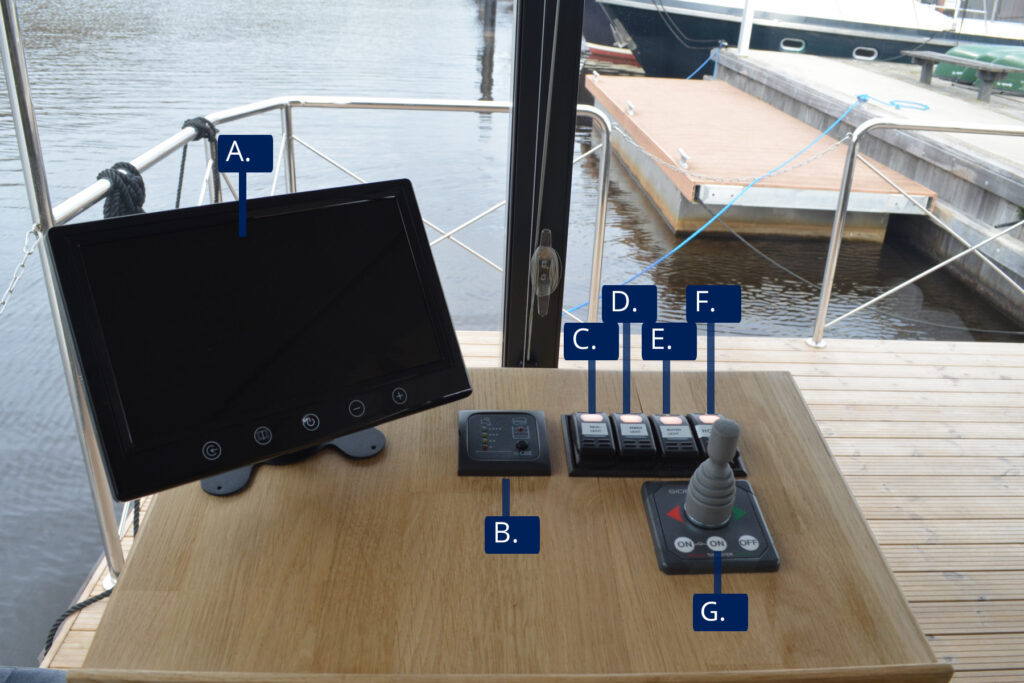
A. Achteruitvaarcamera
B. Indicatie watertank en vuilwatertank
C. Navigatieverlichting
D. Ankerlicht
E. Buitenverlichting
F. Scheepshoorn
G. Boegschroef
Zijpanelen
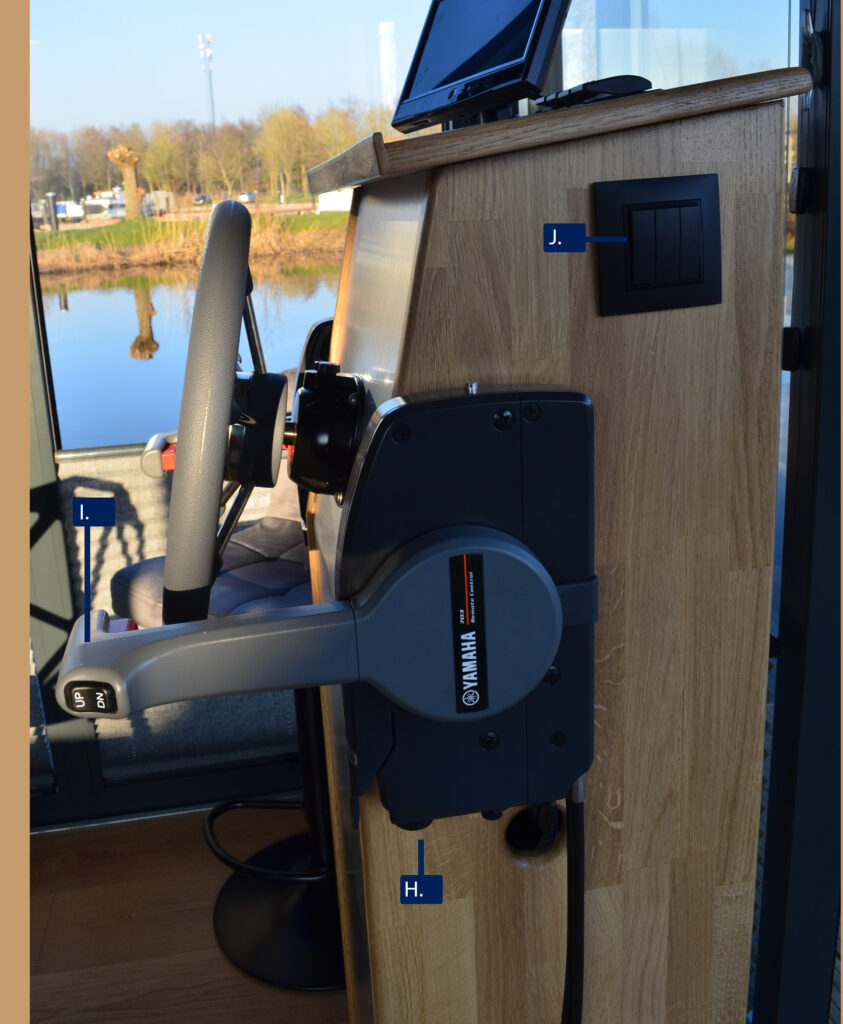
H. Contactslot
I. Gashendel
J. Schakelaars salonverlichting
Start and stop the engine
Starting the engine
Make sure both throttle levers are in neutral. Insert the key into the ignition and attach the kill switch lanyard. Turn the key until the engine starts. In the case of twin engines, perform these steps for both engines. Let the outboard engine(s) warm up for 5–10 minutes before departing.
Throttle lever
Neutral: center position
Forward: push forward
Reverse: pull backward
Tip: Pause briefly (1–2 seconds) when shifting between forward, neutral, and reverse.
Stopping the engine
Turn the key in the ignition back until the engine stops
Bowthruster
This boat has an electric bow thruster. This means that the bow thruster is connected to a separate battery. To use the bow thruster, turn on the system by pushing the joystick to the right while holding down the power button until you hear a beep. The system is now active.
Note: The bow thruster may automatically switch off after some time. Check this in time before maneuvering. Use the bow thruster only for maneuvering.
Using the electric bow thruster
By moving the joystick to the left (port) or right (starboard), the bow (front) of the boat will move in that direction. Use the bow thruster for about 3 seconds (maximum 5 seconds at a time!). Then observe how the boat reacts. If necessary, use it again for another 3 seconds. Continue this way until the desired position is reached.
What to do if the bow thruster doesn’t work
Excessive use of the bow thruster can cause the system to overheat, preventing it from working. Wait approximately 30 minutes before turning it on and using it again. If the system still doesn’t work, the battery is likely empty. Moor the boat and connect it to shore power. Let the boat charge overnight (or at least for several hours) on shore power. If the problem persists, contact us at +31 512 513 276.
Power supply
This Campi Houseboat is equipped with 6 solar panels. These panels charge the batteries. If weather conditions are not ideal for solar charging, it is recommended to find a berth with a shore power connection. We also advise using shore power if the battery voltage is low. Typically, it is possible to spend one night without shore power, but we recommend connecting the boat to shore power the following night.
Additionally, there is an inverter on board, so 220 Volt power is always available on the boat.
What to do if there is no power on board
Check the inverter in one of the compartments on the aft deck. Here you can see how much charge is in the batteries. If the batteries are (almost) empty, you must first connect the boat to shore power to charge the batteries.
If the boat is connected to shore power, make sure it is actually charging. When you connect the shore power cable, you should hear a beep from the inverter. If you are unsure whether the batteries are charging, try connecting the shore power cable to another outlet. If in doubt, ask the harbor master to check if the outlet has power.
If the above information does not help, please contact us at +31 512 513 276.
Heating
The central heating (CV) on the boat runs on gas. Sufficient electrical power is also required for the system to operate. Make sure the radiators (in the cabins) are open so that these areas also get warm. The CV controls both the hot water and the central heating on the boat.
The CV is located in the cabinet in the bathroom. There is a button on the CV to turn it on. The thermostatic knobs on the radiators allow you to control the radiators in the salon and bedroom(s).
What to do if the CV doesn’t work
Error code E1: Check the gas bottle. Is it empty? If so, replace the gas bottle. After replacing it, you may need to reset the CV boiler. Press the middle button at the bottom of the display to reset the CV.
Error code E3: Check the radiators. The CV may not be able to release its heat if the radiators are still closed.
Make sure the temperature on the CV is correctly set to 40–45°C. If the CV is set higher, the system will overheat.
Check if there is power on board. If there is no power, the central heating will not work. If necessary, connect the boat to shore power to charge the batteries.
If the above information does not help, please contact us at +31 512 513 276.
Toilet
The boat is equipped with an electric toilet. Normal use of toilet paper (maximum 2-ply) is fine. Always rinse thoroughly so it doesn’t get stuck in the pipes. Do not throw wet wipes, sanitary pads, or tampons into the toilet, as this can cause blockages.
How does the toilet work?
The toilet has a control panel with buttons:
Eco = flush water for a small load
Normal = flush water for a large load
Empty = fully flush
What to do if the toilet doesn’t work
If the water does not pump away, the toilet is likely clogged. Wait approximately 12 hours to allow the blockage to soften, then press the ‘Normal’ flush button again. If the water still does not pump away, contact us at +31 512 513 276. Costs may be charged for blockages caused by improper use of the toilet.
TV
The boat is equipped with a TV with an antenna. You can receive the channels Nederland 1, Nederland 2, Nederland 3, and the regional channels. It is also a SMART TV, which allows you to connect the TV to the internet and use the SMART features. Connect the TV to the marina’s Wi-Fi or your own hotspot.
How does the TV work?
Turn on the television and the antenna receiver using both remote controls.
Make sure the television is set to HDMI.
A channel number will appear on the antenna receiver, and the TV screen will display the image.
Use the antenna remote to change channels.
What to do if the TV doesn’t work
Check if the issue is with the antenna reception and try moving the antenna to a different position. Also, check that the TV cables are properly connected: the TV plug in the power outlet and the satellite receiver plug in the HDMI port. If you still experience problems with the TV, contact us at +31 512 513 276.
Info above deck
Outboard engines
This Campi 400 is equipped with two 30 HP outboard engines. These are located on the aft deck of the boat. When the throttle lever is in the middle, it is in neutral. The boat can only be started in this position. Push the lever forward to move forward and pull the lever back to go in reverse.
The outboard engine has an automatic choke, so when you turn the ignition key, the engine will start running. Then let the engine warm up properly (depending on the outside temperature) by running it for about 10 minutes. Only when the engine is fully warmed up should you start sailing. If the engine is not fully warm, it may stall when changing gears or accelerating. This can be especially dangerous when maneuvering in harbors.
Gaslocker
The gas locker is located on the aft deck of the Campi, inside one of the compartments. There are 2 gas bottles: 1 connected and 1 spare. When you take over the boat, the gas bottle is always connected and open. If the gas bottle is empty, you will need to replace it yourself.
Replacing the gas bottle:
Close the valve of the connected bottle.
Loosen the nut of the pressure regulator using the supplied key (left-hand thread).
Connect the pressure regulator to the other gas bottle.
Open the valve of the newly connected gas bottle.
Note: After connecting a new gas bottle, there may be air in the hose/line, which can make it difficult to restart the central heating (CV). To prevent or resolve this, you can briefly turn on the gas stove for a few seconds to push the air out of the lines. After this, you can restart the CV.
Shore power
The shore power cable belongs to this boat. Always make sure to disconnect the shore power cable from the dock and bring it on board before departure. Reconnect the shore power cable upon arrival at the marina.
Fenders
The Campi Houseboat is equipped with fenders all around. Make sure the fenders are securely fastened to the railing so you don’t lose them while underway. See the section on ‘Knots’ to learn how to attach a fender using a clove hitch. Questions? Feel free to ask the instructor to show you how to tie the knot. Ensure that there are enough fenders positioned between the boat and the dock or quay when mooring.
Boat lines
The boat has 4 mooring lines, one at each corner of the boat (port bow / starboard bow / port stern / starboard stern).
Loop the line around the cleat on the boat. Pass the line under the railing to the cleat or ring on the dock/shore. Do not secure the line yet! Bring the line back to the cleat on the boat and fasten it using a clove hitch or bowline. See the ‘Knots’ section to learn how to tie these knots.
This method allows you to easily release the line from the boat without having to step onto the dock. If needed, you can use a boat hook to help. Questions? Feel free to ask the instructor to show you how to tie the knots.
Navigation lights
If you are sailing during the day (between sunrise and sunset) with good visibility, you do not need any lights. However, when visibility decreases due to fog, rain, or other weather conditions, it is mandatory to turn on the navigation lights. Use the buttons on the helm to switch the lights on and off.
Refilling water
At the back of the boat, inside one of the compartments, is the cap for the drinking water tank. Before departure, the water tank will already be filled for you. If you refill the water tank while underway, always let the water run briefly so that fresh water flows through the hose. Place the hose in the fill opening and fill the water tank. Check the indicator light at the helm to see if the drinking water has been replenished.
Although the water tank is filled with drinking water, we recommend not drinking it directly and using bottled water instead. It is advised to refill the water tank every 2–3 days.
Emptying the waste watertank
At the rear of the aft deck is the cap for the wastewater tank. To pump out the wastewater tank, unscrew the cap and attach the hose from the wastewater pump securely so it is airtight. Once the wastewater tank is empty, disconnect the hose from the pump and screw the cap back onto the tank.
Upon your return, we will empty the wastewater tank. If the tank becomes full while underway, you will need to locate a pumping station yourself. See the list of wastewater stations here.
Refueling
The Campi Houseboat runs exclusively on Euro 98/E5 gasoline. In one of the compartments on the aft deck, you will find the fuel tanks. To fill the fuel tank, first close the vent, then disconnect the hose and remove the fuel tank from the compartment to fill it. After filling, reconnect the hose and slightly open the vent on top of the tank.
Start the engine at the helm. If the outboard engine does not start immediately, you can use the squeeze bulb on the outboard motor to push some extra fuel toward the engine. Then try starting it again.
Problems with the engine? Call +31 512 513 276. Upon returning to the marina, our staff will always refill the fuel tank. The cost of the fuel used will be deducted from the deposit. See here for a list of fuel stations on the water.
Service | Questions| Contact
The team members of Team De Drait have done their utmost to prepare the boat for you. However, it’s still possible that an unexpected issue may arise during your boating holiday. If that happens, please first consult the information in the onboard manual. Still have a question or problem after reading the manual? We are always here to help you. Please contact us via:
-Email: contact@dedrait.com
-Phone: +31 512 513 276