Drait 104
Renal 36
Dimensions + technical data
Length: 11,00 meters
Width: 3,85 meters
Draft: 1,10 meters
Clearance height: 4,50 meters
Water tank: 500 litres
Waste water tank: 100 litres
Fuel tank: 500 litres
Steering position Drait 104
Stuurstand
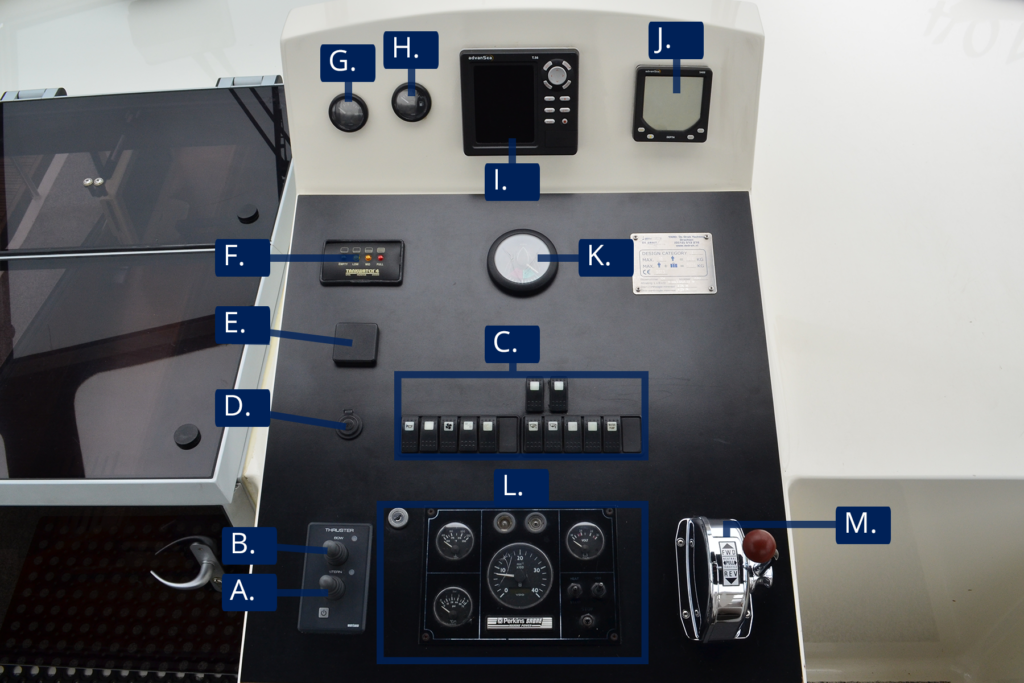
A. Hekschroef
B. Boegschroef
C. Schakelaars (zie hieronder)
D. 12/24 Volt
E. 220 Volt
F. Vuilwatertank
G. Watermeter
H. Brandstofmeter
I. Kaartplotter
J. Dieptemeter
K. Roerstand
L. Motorpaneel (zie hieronder)
M. Gashendel
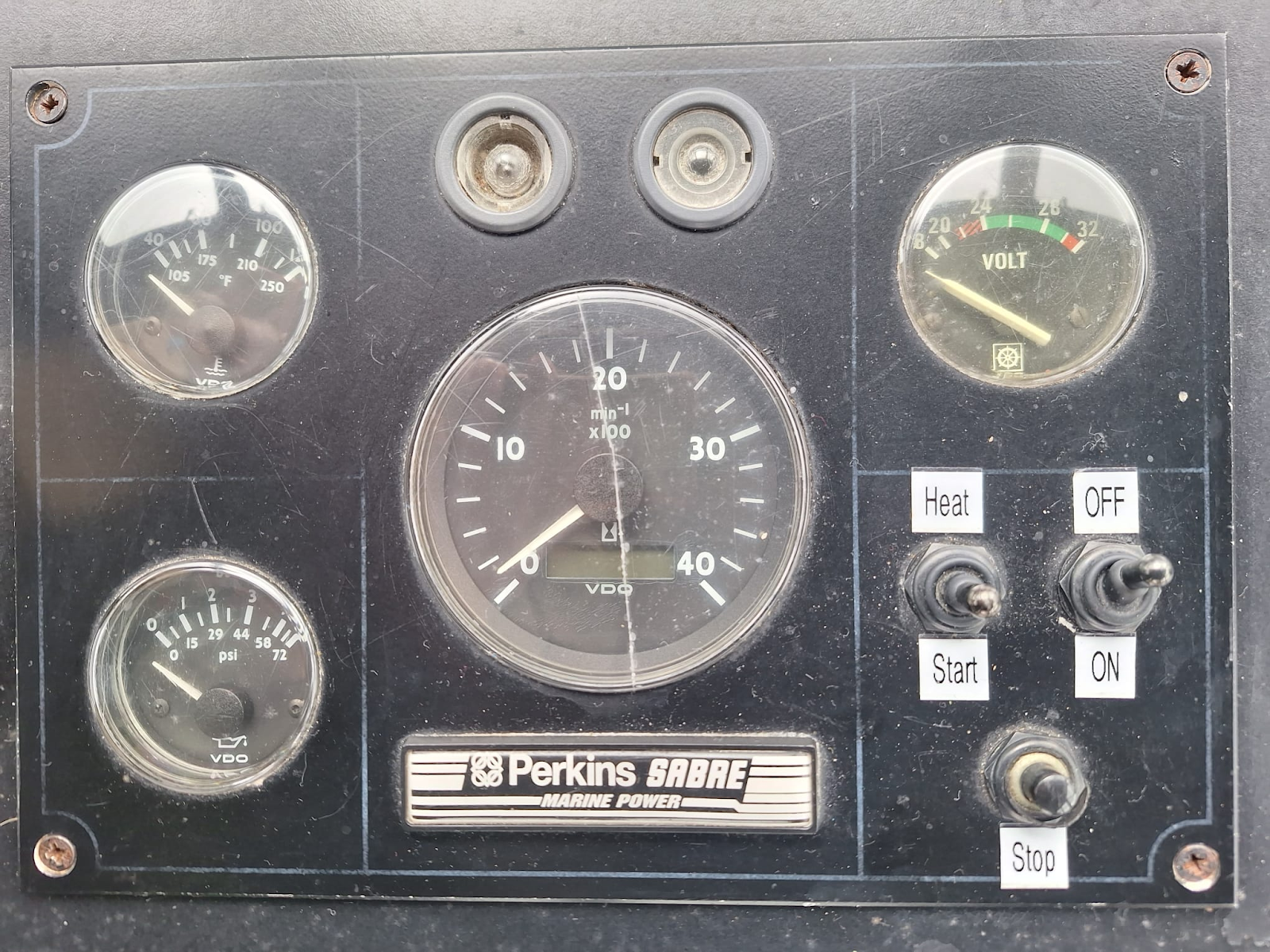
Motorpaneel
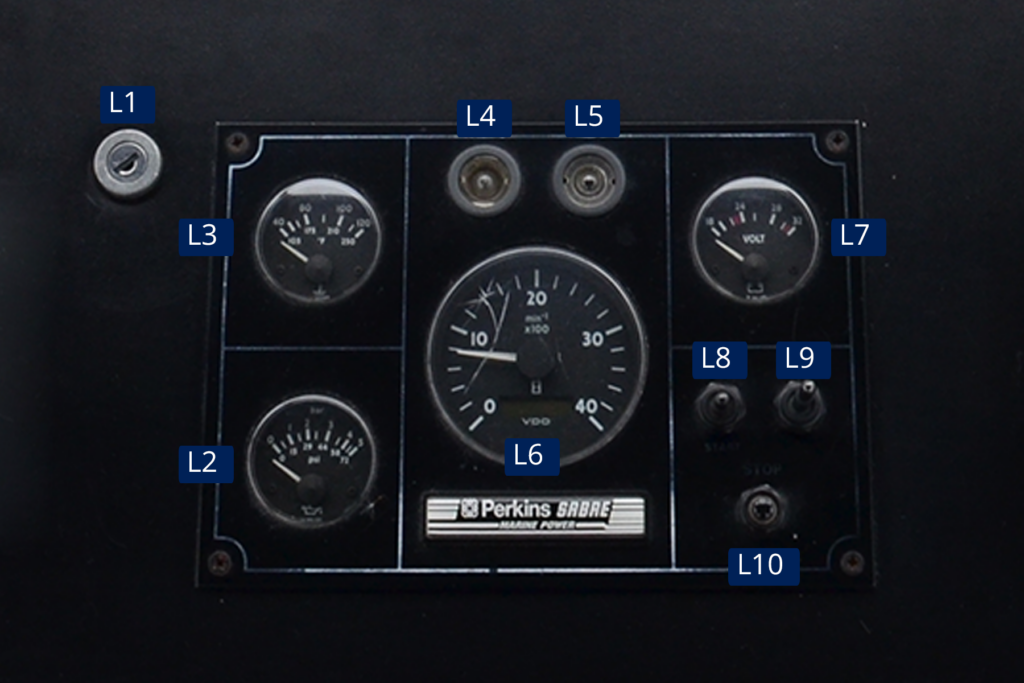
L1. Contactslot
L2. Oliedruk
L3. Motortemperatuur
L4. Water in brandstofalarm
L5. Verlichting motorpaneel
L6. Toerenteller
L7. Accuspanning
L8. Motor startknop
L9. Ontsteking aan/uit
L10. Motor stopknop
Schakelaars
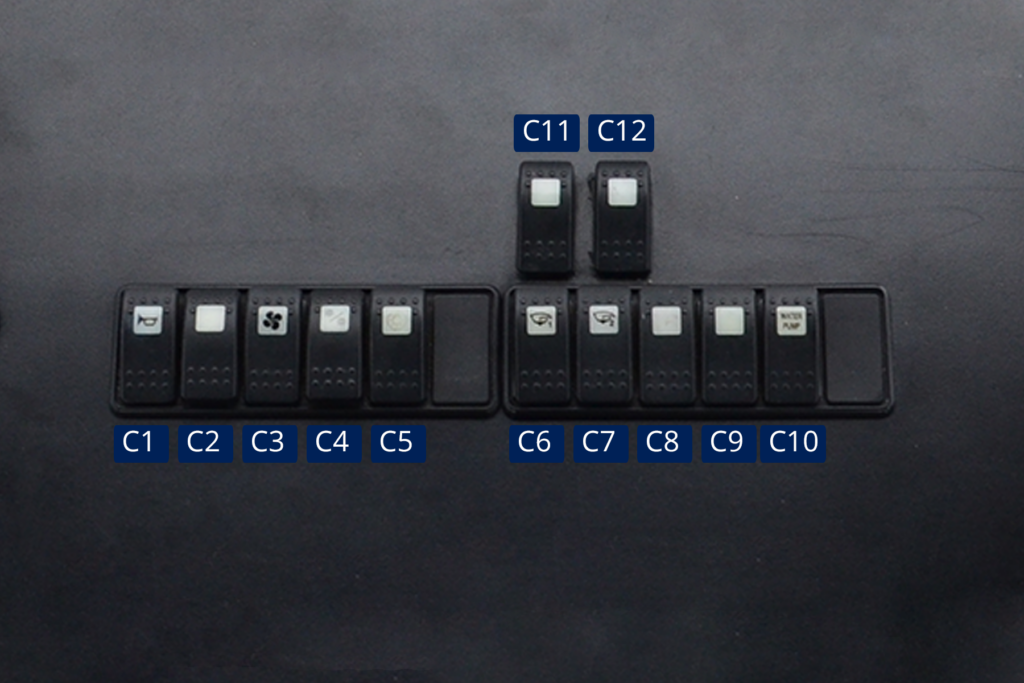
C1. Scheepshoorn
C2. –
C3. Stuurstand ventilator
C4. Navigatielicht/ankerlicht
C5. Trapverlichting
C6. Bilgepomp 1
C7. Bilgepomp 2
C8. Bilgepomp 3
C9. –
C10. Waterpomp
C11. Ruitenwisser
C12. Ruitenwisser
Start and stop the engine
Starting the Engine
Make sure the throttle is in the neutral position. Insert the key into the ignition and turn it. Then switch on the engine panel by moving the switch in the upper right corner (OFF/ON) downward. You should now see the gauges turn on. Use the left switch (Heat/Start) to preheat the engine. Push the switch upward for 5 seconds. After 5 seconds, push the switch downward until you hear the engine start.
Throttle
Neutral: middle position
Forward: push forward
Reverse: pull backward
Tip: Take a short pause (1–2 seconds) when shifting between forward, neutral, and reverse.
Stopping the Engine
Press and hold the stop button until the engine turns off. Then switch off the engine panel by moving the switch in the upper right corner upward. Remove the key from the ignition.
Bow-and stern Thruster
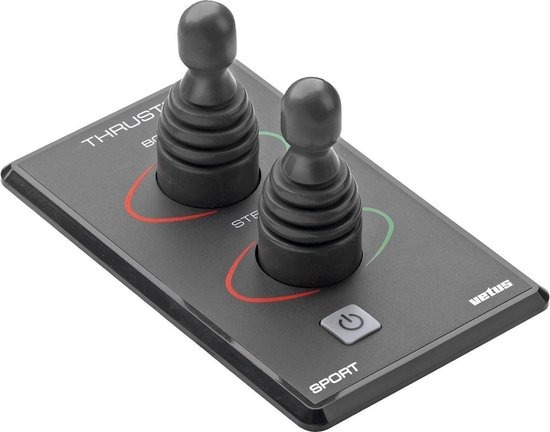
This boat is equipped with a hydraulic bow thruster and stern thruster. This means the thrusters are not connected to a battery that can run out of power. The hydraulic system only operates when the engine is running.
To use the bow or stern thruster, you must activate the system by pressing the power button twice. You will hear a beep. After pressing the button once, the beeping sound will continue, but the system is not yet active. Only after pressing the button a second time will the beeping stop after a few seconds, and the bow and stern thrusters can be used.
Important: always switch off the bow and stern thrusters after your trip. To do this, press the same power button once. You will hear a beeping sound again, and after a few seconds the system will switch off.
Use the bow or stern thruster only when maneuvering.
Using the Hydraulic Bow and Stern Thrusters
When you move the bow thruster joystick to the left, the front of the boat moves to the left. When you move the bow thruster joystick to the right, the front of the boat moves to the right. The same applies to the stern thruster, but this affects the rear of the boat.
Use the bow or stern thruster for about 3 seconds (maximum 5 seconds at a time). Then observe how the boat responds. If necessary, apply the thruster again for another 3 seconds. Continue this process until the desired position is reached.
Do NOT use the bow and stern thrusters simultaneously. This causes a loss of power, which means it will take longer to reach the desired position. Alternate the use of both thrusters for the best result.
What to do if the bow or stern thruster does not work
If the bow or stern thruster does not work on this boat, please contact us at +31 512 513 276.
Power supply
The boat has multiple batteries:
-A battery for starting the engine (starter battery);
-A battery for the bow and stern thrusters (except in the case of hydraulic thrusters);
-A battery pack for onboard power (house batteries).
While cruising, the batteries are slowly recharged. However, charging is much faster when the boat is connected to shore power. Therefore, if the battery voltage is low, we recommend finding a berth with a shore power connection.
It is generally possible to spend one night without a shore power connection, but we advise connecting the boat to shore power the following night.
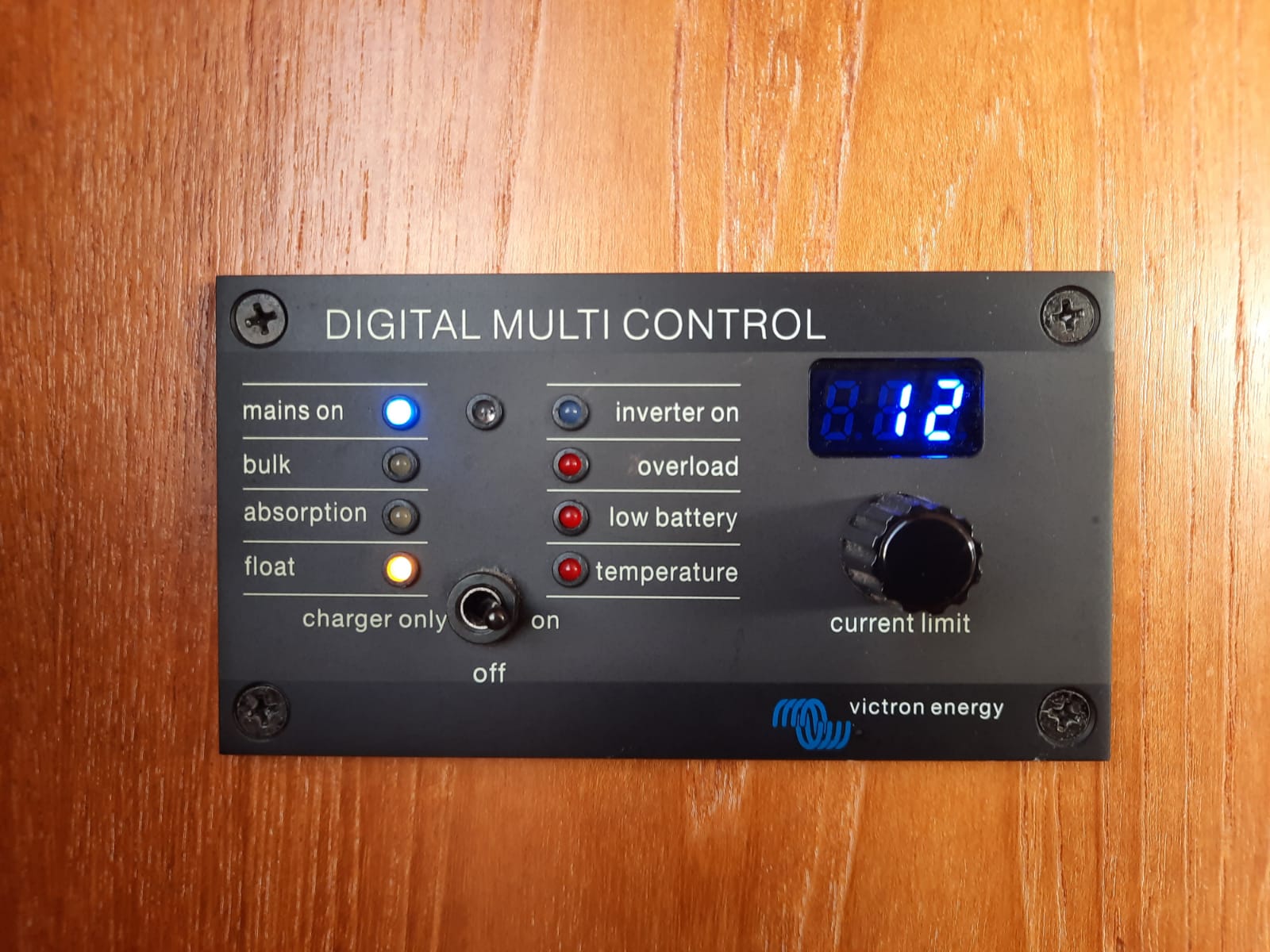
In the salon, you’ll find a control panel for the inverter (Victron Energy, see photo). Make sure the inverter is always set to ‘on’. There is also a rotary knob to adjust the number of Amps. This is usually set between 8 and 12 Amps by default. It’s important that the Amp setting is equal to or lower than the number of Amps available at the shore power connection.
For example, if a marina provides 12 Amps at the power pedestal, you can set the knob to 12. If the knob is set higher than the available shore power, the fuse may trip. In that case, reduce the Amp setting and reset the fuse.
What to do if there is no power on board?
Check the power supply on board at the fuse box (located in the salon). Check the indicator lights for 230V via the inverter and 230V via shore power. Also check if any fuses in the fuse box have tripped. No indicator light? Check if the power outlets are working and whether the fridge is still running. If these also have no power, the battery voltage is likely too low, and you should first connect the boat to shore power so the batteries can recharge.
If the boat is connected to shore power, check if it is actually charging. Some boats are equipped with a battery monitor in the salon, which can be used to check whether the batteries are being charged. You can also verify this on the inverter panel or by checking the indicator lights in the fuse box. Not sure if the batteries are being charged? Try plugging the shore power cable into a different outlet. If in doubt, ask the harbor master to check whether the power pedestal is supplying electricity.
- Check the inverter control panel in the salon:
Skyla control – Victron Energy:
–Charger on = Shore power is connected and the batteries are charging.
–Boost charging = Battery voltage is low, charging at full power.
–Float charging = Batteries are charged, being maintained/trickle charging.
Digital Multi Control – Victron Energy:
–Mains on = Shore power is connected and batteries are charging.
–Bulk = Battery voltage is low, batteries charging at full power.
–Absorption = Battery voltage is higher (80–90%), still charging.
–Float = Batteries are charged and being maintained/trickle charging.
–Inverter on = Inverter is active because shore power is not connected.
–Overload = Batteries are overloaded due to high power consumption.
–Low battery = Batteries are deeply discharged; this light stays on if shore power is not connected properly.
–Temperature= Batteries are getting hot; often lights up along with overload. - If there are no lights on the inverter panel, check the inverter switch in the fuse box. Is it off? Switch it on. Is it already on? Switch it off, wait one minute, then switch it back on. This will reset the inverter.
- If none of the above helps, please contact us at +31 512 513 276.
Heating
The central heating system on the boat runs on diesel. In addition, sufficient electrical power is required for the system to operate. In the saloon there is a thermostat, which allows you to set the heater to the desired temperature. Make sure that the radiators (in the cabins) are open so that these areas also become warm.
Please note: always check that there are no fenders hanging in front of the heater’s exhaust before switching the heater on.
This boat is equipped with a Maritime Booster heater. This system provides both hot water and central heating on board.
What to do if the heater is not working?
First, check the power supply on board in the fuse box (in the saloon). Check the indicator lights for 230 volts via the inverter and for 230 volts via shore power. Also check whether a fuse has blown in the fuse box (often indicated with a sticker “CV”).
No indicator light? Check whether there is power at the sockets and whether the refrigerator is still working. If there is no power there either, the battery voltage is probably too low. In that case, first connect the boat to shore power so the batteries can recharge.
Does the heater still not work after charging? Then check the heater in the engine compartment. Open the engine hatch and look for the blue box labeled “Maritime Booster.” Press the red button on the front of the heater to reset it. Wait a few seconds to see if the heater starts up again.
If this does not help either, please contact us at +31 512 513 276.
Toilet
The boat is equipped with an electric toilet. Normal use of toilet paper (maximum 2-ply) is not a problem. However, always flush well to prevent it from getting stuck in the pipes. Do not throw wet wipes, sanitary pads, and/or tampons into the toilet! This can cause blockages.
How does the toilet work?
The toilet has two buttons that look like light switches. One button is for adding water to the toilet bowl. The other button is for flushing (pumping out) the contents. Always flush properly to ensure everything is cleared. Make sure a small layer of clean water remains in the bowl after use to prevent unpleasant odours.
What to do if the toilet does not work?
If the water doesn’t flush away, the toilet is likely clogged. Wait approx. 12 hours before using the toilet again to allow the blockage to soften. Then press the flush button again. If the toilet still does not work, please contact us at +31 512 513 276. If the blockage is caused by incorrect use of the toilet, charges may apply.
TV + radio
The boat is equipped with a TV and antenna. With this system you can receive the channels Netherlands 1, Netherlands 2, Netherlands 3, and the regional channels.
How does the TV work?
Does the boat have a fixed antenna? If so, you do not need to do anything at this step. If the boat has a portable antenna, place the loose antenna at the top of the wheelhouse next to the access hatch for the best reception.
Then switch on both the television and the antenna receiver using their respective remote controls.
Check that the television is set to HDMI.
A channel number will now appear on the antenna receiver, and an image will also appear on the TV.
Use the antenna remote control to change channels.
What to do if the TV is not working?
Check whether the issue is related to antenna reception and place the antenna in a different position. Also check whether the TV cables are connected correctly: the TV plug should be in the power socket and the satellite/antenna receiver plug should be connected to the HDMI port.
If you still experience problems with the TV after this, please contact us at +31 512 513 276.
Radio
The boat is equipped with a car radio. You can switch the radio on using the “on” button and then use it as normal. Please make sure not to cause any noise disturbance. Check which stations you can receive on which radio frequencies here.
Info above deck
Check the cooling water from the exhaust
The boat is equipped with a water-cooled engine. This means that outside water is used to cool the engine. Therefore, it is very important to always check whether cooling water is coming out of the exhaust.
If no cooling water, or only a small amount, is coming out of the exhaust, pull out the throttle lever on the side so you can apply throttle while in neutral. Gently increase the throttle and check whether this affects the amount of cooling water. Do not forget to return the lever to neutral afterwards and click it back into place, so the throttle can be used normally again.
If this does not produce the desired result, switch off the engine as soon as possible to prevent overheating and call +31 512 513 276 immediately.
Has a colleague instructed you to check the seaweed strainer? If so, follow these steps:
Open the engine hatch in the saloon.
Locate the seaweed strainer(s) connected to the engine and carefully unscrew the cap.
Note: there is a rubber sealing ring between the cap and the strainer housing. Do not lose this ring!Remove the filter and clean it in outside water or at a water tap in the marina.
Reinstall the cleaned filter, then replace the rubber ring and the cap. Make sure the cap is closed airtight.
Start the engine and check whether cooling water is now coming out of the exhaust.
Gasbun
The gas locker is located under the hatch on the foredeck. There are 2 gas bottles here: 1 is connected and 1 is a spare. When you take over the boat, the gas bottle is always connected and open. If the gas bottle is empty, you must replace it yourself.
Replacing the gas bottle:
1. Close the valve of the connected bottle;
2. Loosen the nut of the pressure regulator using the provided wrench (left-hand thread);
3. Connect the pressure regulator to the other gas bottle;
4. Open the valve of the newly connected gas bottle.
Shore Power
The shore power cable belongs to this boat. Always make sure to disconnect the shore power cable on shore and bring it on board before departure. Reconnect the shore power cable upon arrival at the marina. Check whether the light ‘Charger on’ or ‘Mains on’ is illuminated on the inverter control panel (in the salon). This indicates that the batteries are being charged. Also check the number of amps available at the power pedestal. Adjust this if necessary on the inverter control panel. If you have any questions, it’s best to ask the harbor master or contact us.
Fenders
The boat has 6–8 fenders. Make sure the fenders are securely attached to the railing to avoid losing them while cruising. Check the ‘Knots’ section under ‘Theory’ to see how to tie the fender using a clove hitch. Questions? Feel free to ask the instructor to demonstrate how to tie the knot.
Make sure the fenders are not hanging in front of the heater exhaust! This can cause exhaust fumes to be drawn back inside, which may lead to carbon monoxide poisoning. The fender may also melt due to the heat.
Boat Lines
The boat has 4 lines, one on each corner of the boat (left front / right front / left rear / right rear). Place the loop around the cleat of the boat. Pass the line under the railing to the cleat/ring on the dock/shore. Do not secure the line yet! Bring the line back to the cleat on the boat and secure it with a clove hitch or round turn and two half hitches. Check the ‘Knots’ section under ‘Theory’ for instructions on how to tie these knots. This way, you can easily release the line from the boat without having to stand on the dock. If necessary, you can use the boat hook to assist. Questions? Feel free to ask the instructor to demonstrate how to tie the knots.
Anchor
The anchor winch is located on the foredeck. The bar to operate it can be found in the gas locker. To lower the anchor, loosen the nut with the 3 pins using the bar. This will release the chain wheel, and the anchor will drop. Remember: no fingers near the chain! To raise the anchor, use the same bar but insert it into the hole on the other side of the winch. By moving the bar back and forth, you will lift the anchor. For the final part, it’s best to guide the anchor with the boat hook so that it sits correctly against the anchor plate without causing damage to the hull of the boat. If you are anchored, you should hang the anchor ball in the mast (located in the cabinet in the salon next to the stairs). Important: Anchoring is not permitted at dusk or during the night. Make sure to find a mooring in time, such as a Marrekrite spot or in a marina.
Navigation lights
If you are sailing during the day (between sunrise and sunset) with good visibility, you do not need any lights. However, when visibility decreases due to fog, rain, or other weather conditions, it is mandatory to turn on the navigation lights. Use the ‘navigation lights’ switch on the control panel in the saloon to turn the lights on and off.
Refilling Water
Halfway along the ship, on the starboard side, you will find the cap for the drinking water in the gangway. The water tank has already been filled for you before departure. If you need to refill the water tank during your trip, always let the water run briefly to ensure fresh water comes out of the hose. Place the hose in the filling hole and fill the water tank. If water starts coming out of the vent opening on the side of the ship, or if the water overflows at the fill cap, this means the water tank is full. Although the water tank is filled with drinking water, we advise against drinking it and recommend using bottled water instead. It is also recommended to refill the water tank every 2-3 days.
Refilling fluel (GTL)
Halfway along the ship, on the port side, you will find the cap for the fuel tank in the gangway. This boat runs exclusively on GTL diesel. Regular diesel must not be used for refueling during the trip. The tank is large enough for a two-week journey. Upon your return, we will refuel the boat for you. Please refer to the list of fuel stations along the water, which you will find here.
Tent
Before opening and closing the zippers, check if it’s necessary to relieve some of the tension by loosening the straps. On most boats, the front windows can be rolled up, and the sides and back can be opened. This allows enough fresh air to flow through the tent while maintaining the sunroof. Our advice is NOT to remove the entire tent from the boat. The reason for this is that the tents are often tightly fitted, making it difficult to reattach them properly afterwards. Any damage to the tent/boat caused by incorrect handling against the advice of De Drait is at your own risk.
If it is still necessary to remove the tent, ask our instructor during the briefing what is important to pay attention to, especially when reattaching the tent and the cockpit cover. You must return the boat in the same condition you received it. If the tent/tent parts have been removed, they must be reinstalled upon return.
Service | Questions | Contact
The team members of Team De Drait have done their utmost to prepare the boat for you. However, it’s still possible that an unexpected issue may arise during your boating holiday. If that happens, please first consult the information in the onboard manual. Still have a question or problem after reading the manual? We are always here to help you. Please contact us via:
-Email: contact@dedrait.com
-Phone: +31 512 513 276